
Fire was always a danger to early frontier communities and occasionally one or another of the community's structures burned. Virtually every sawmill in the City burned at least once during the life of the industry. In September 1888, the residents of Ashland received quite a start when a large brush fire west of town convinced our neighbors across the bay that the City was burning. A week later fire did devastate portions of the business community destroying 35 businesses within two hours of its origin and caused $120,000 in damage. Fortunately, the disaster did not result in the loss of life. Like the famous Chicago fire, the Washburn fire was alleged to have started as the result of an animal kicking over a lantern in a shed.
By 1888, the A. A. Bigelow Lumber Company operated the second largest mill in Wisconsin and contained the largest refuse burner in the world.
The "Great Forest Fire of 1894" once again endangered the community. Every able bodied man was recruited to fight the blaze. A fortunate wind change eventually saved the City.
By 1896, the community boasted a population of 6,000, contained three weekly newspapers, nine churches, 15 saloons, three banks, 21 boarding houses, an opera house, brewery, four blacksmith shops, two liveries, and a veterinarian.

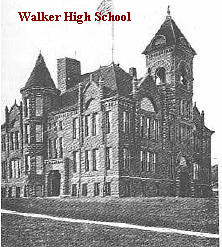
The city's waterworks was constructed in 1889 and the Walker High School, a Lake Superior Brownstone castle was constructed in 1893 for a cost of $62,000. Named after an official of the A. A. Bigelow Lumber Company, the new structure was dedicated on May 28, 1894.
In 1899, the Washburn Elevator loaded the steamer W. H. Oliver with the largest cargo floated on the lakes up to that time - 152,000 bushels of barley; 40,000 bushels of rye; and 149 bushels of oats equaling a cargo of 7,149 tons destined for Buffalo, New York.
In 1904 the community was incorporated as a City, a creamery began business, its residents were provided with electric lights, and a Carnegie Library was constructed. Despite the ongoing decline of the City's foundation industry, forest products, the Dupont Company purchased some 2,000 acres of land outside the community and established the largest dynamite plant in the northwest. The Barksdale Works manufactured a complete line of dynamite and gelatin dynamites for mining, forestry, agricultural applications. Washburn became a boom town by World War I with more then 9,000 residents. The Barksdale plant alone employed 6,000 area residents during the World War.
In 1910, the first automobile entered the City having traveled from Redwood Falls, Minnesota. The two day trip was hampered by the lack of travelable roads between Drummond and Washburn.
Following the trends of the national temperance movement, the City voted to go dry in 1914 causing its brewery to close.
Boom times returned to the community during the World War. The Barksdale Works of the Dupont Company employed upwards of 6,000 men and women in support of the war effort. Washburn's population allegedly peaked at 10,000 during the war and the community was hard pressed to provide housing and educational opportunities for the influx of new families. Dupont arranged for the construction of a significant amount housing in the community to alleviate the shortage of housing endured by its employees. While many remain on the City's East 3rd Street in what is called "Dupont Row" today, many were sold to the expanding Marshall -Wells Hardware Company and moved to Duluth, Minnesota after the war.
The City added to its industrial base in 1921 when Anchor Shipbuilding opened a ship yard in Washburn. Unfortunately, the company only constructed one vessel during its existence, a steel double ended ferry that transported traffic across the Hudson river in New York state. The vessel, the Hudson-Athens, was launched on June 25, 1921.
The City became the home of the district headquarters of the Chequamegon National Forest in the 1930's and remains so today. Thousands of acres of national and county forest lands surround the community providing endless recreational opportunities and a managed timber source for Wisconsin's forest products industry.
The City's water system was purchased in the 1930's and updated forty years latter with the conversion from lake water to artesian water and the construction of a storage reservoir. A primary sewage treatment plant was constructed in 1958, upgraded in 1973 and replaced in 1998. Portions of both the water and sanitary sewer saw major reconstruction in 2004. The sewage treatment plant was upgraded again in 2016.
The Walker School was razed by fire on February 5, 1947. Ground was broken on the new Washburn High School in 1949.
The Barksdale Works of the Dupont Company closed in 1971.
With the decline of the areas industrial base, rail service, the reason for the founding of the community, was discontinued between Washburn and Bayfield in 1977 and abandoned into the community several years later.
Sources:
- Washburn Memories, Washburn Women's Civic Club; 1982?; Edith Merila, editor. Printed by White Birch Printing, Inc., Shell Lake, Wisconsin.
- "The Mills of Washburn," by Kurt Larson. Tall Timbers Shortlines; Fall, 2000.
- Washburn Comprehensive Plan, Northwest Regional Planning Commission, 1992 Update.
- Small Town USA II, Washburn Wisconsin by A.H. Woiak; publication date unknown.
- The Wisconsin Blue Book; The Wisconsin Legislative Reference Library; 1960.